


TL;DR
- X in-app trading has been discussed since mid-2025, and recent Smart Cashtags testing shows progress on the user interface layer.
- Smart Cashtags currently link posts to in-app asset pages with price data and charts, not to a confirmed, fully licensed X trading platform.
- Any rollout of stock or crypto functionality would likely begin in the U.S., as securities trading would require SEC registration, FINRA membership, or a disclosed brokerage partner.
X (formerly Twitter) is once again drawing attention for its reported plans to introduce X in-app trading. In recent weeks, coverage has focused on the testing of “smart cashtags,” clickable asset symbols embedded directly in posts. The broader initiative, however, dates back to mid-2025.
At that time, reporting by the Financial Times cited public comments from CEO Linda Yaccarino outlining ambitions to expand the platform into financial services. She described a long-term strategy to integrate payments and investing features as part of an “everything app” vision. Nearly a year later, renewed focus on smart cashtags suggests product development is advancing. Whether the underlying platform infrastructure is ready to support live trading on X remains unclear.
The Timeline Behind X In-App Trading
Plans for in-app trading on X first surfaced in the summer of 2025. Leadership framed the idea as part of a broader transformation that would combine social networking, payments, and financial services in a single interface, aligning with Elon Musk’s vision of turning X into a super app.
In the months that followed, several crypto and fintech outlets revisited the story. Coverage shifted toward operational questions. Observers asked how X stock trading might function. Others questioned whether X crypto trading would be included in a future rollout. Speculation also touched on Dogecoin, though no formal announcement tied the asset to a specific product.
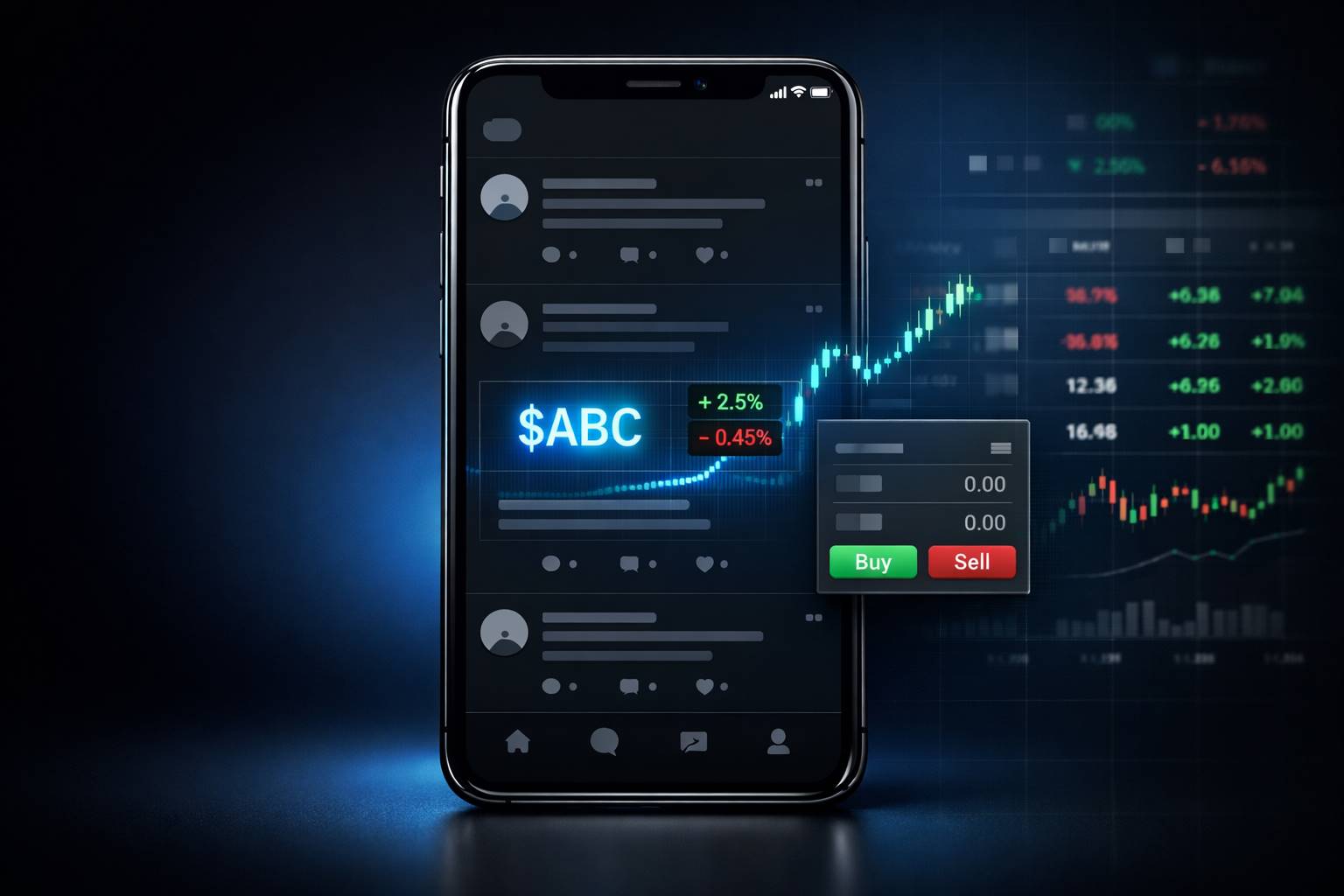
More recently, attention has centered on smart cashtags. This feature allows users to click on an asset cashtag in a post and view an in-app page displaying real-time or near real-time price data, charts, and related content. These pages connect social conversation to market information. At present, they do not constitute live trading functionality. Even so, their introduction has revived discussion about the development progress of an X trading platform.
What Smart Cashtags Mean for X as a Trading Platform
Smart cashtags represent a front-end feature. They link social content to asset data within the same interface. Users can move from a post to a price page without leaving the platform.
This shift reduces friction between discussion and market information. If fully implemented alongside appropriate regulatory approvals, in-app trading could allow X users to move from viewing market data to executing trades directly within the feed.
However, smart cashtags alone do not confirm that a regulated execution system is operational. A clickable ticker does not equal a licensed brokerage. Interface testing can occur independently of a fully operational backend.
The distinction matters. Embedding trading inside X would represent a structural change in how users interact with financial markets. Yet the existence of smart cashtags does not by itself establish that the X trading platform is licensed or live.
The Infrastructure Required for a Trading Platform
Operating a trading platform in the United States typically involves several regulatory layers. In the United States, firms that facilitate customer securities trades generally must register as broker-dealers with the U.S. Securities and Exchange Commission (SEC) and typically become members of the Financial Industry Regulatory Authority (FINRA), either directly or through a partner.
A fully operational trading platform would also typically involve clearing arrangements, custody solutions, and AML/KYC compliance systems. These components form the execution layer of most brokerage models.
To date, there has been no public announcement that X has received SEC approval for an in-app securities trading product. Public reporting so far has not identified a specific brokerage partner for an X trading product, either. Neither has X publicly acknowledged a broker-dealer entity specifically tied to its in-app trading feature.
Can users already trade stocks or crypto directly inside X? There has been no public confirmation that live securities or crypto brokerage functionality is available. The available information indicates that current features are limited to market data and asset pages.
>>> Related: Polymarket X Partnership Brings Prediction Markets Mainstream
Why the United States Would Likely Be the First Testing Ground
X Payments LLC has obtained money transmitter or similar licenses in multiple U.S. states, supporting payment services on the platform. These licenses are distinct from the registrations typically required to offer securities trading.
They underpin domestic payment functionality. They do not, by themselves, authorize stock trading or crypto trading on X. Offering securities or brokerage services would require additional approvals or partnerships.
There has been no public indication yet that equivalent brokerage approvals have been obtained in the European Union or the United Kingdom. Any international expansion of X in-app trading would therefore require separate regulatory authorization in each jurisdiction.
For that reason, if a full X trading platform were introduced, a U.S. rollout would likely serve as the initial testing ground. Such an approach would align with the company’s documented licensing activity in the payments space.
The Behavioral Implications of Embedded Trading
If X evolves into a fully licensed trading platform, the integration of social discourse and transaction capability could alter user behavior. Market discussions already occur in real time on the platform. Embedding execution tools within the same environment could significantly shorten the distance between information and action.
In that scenario, stock and crypto would trade inside the same interface where sentiment spreads. X’s platform would function both as an information venue and, subject to regulatory approval, as a transaction venue.
Such a model depends on regulatory clearance and operational readiness. Until those elements are publicly confirmed, smart cashtags remain a product feature focused on market data rather than proof of a completed X trading platform.
>>> Related: Can X Chat Deliver Privacy Without Ads?
Vision Confirmed, Infrastructure Undisclosed
The ambition behind X in-app trading has been publicly articulated since mid-2025. Recent smart cashtag testing indicates continued progress at the product level. What has not been publicly detailed is whether the full execution framework required for a licensed brokerage is in place.
The development of an X trading platform involves more than interface design. It would require appropriate registrations, regulatory oversight, and operational partnerships. As reporting continues, concrete disclosures regarding licensing or brokerage arrangements will provide clearer signals of readiness.
For now, the interface appears to be evolving, but the infrastructure beneath it has yet to be publicly confirmed.