


TL;DR
- Do Kwon was sentenced to 15 years in U.S. federal prison for fraud tied to the TerraUSD and LUNA collapse, marking one of the harshest penalties in a crypto case to date.
- The U.S. sentence does not automatically end his legal exposure. South Korean prosecutors may still pursue a separate trial against Kwon under domestic financial law.
- Any potential second trial would depend on a prisoner transfer process after years of incarceration, not immediate extradition.
- Even as courts delivered a definitive ruling, parts of the crypto market treated the verdict as a tradable event, with prediction markets and short-term token volatility following the news.
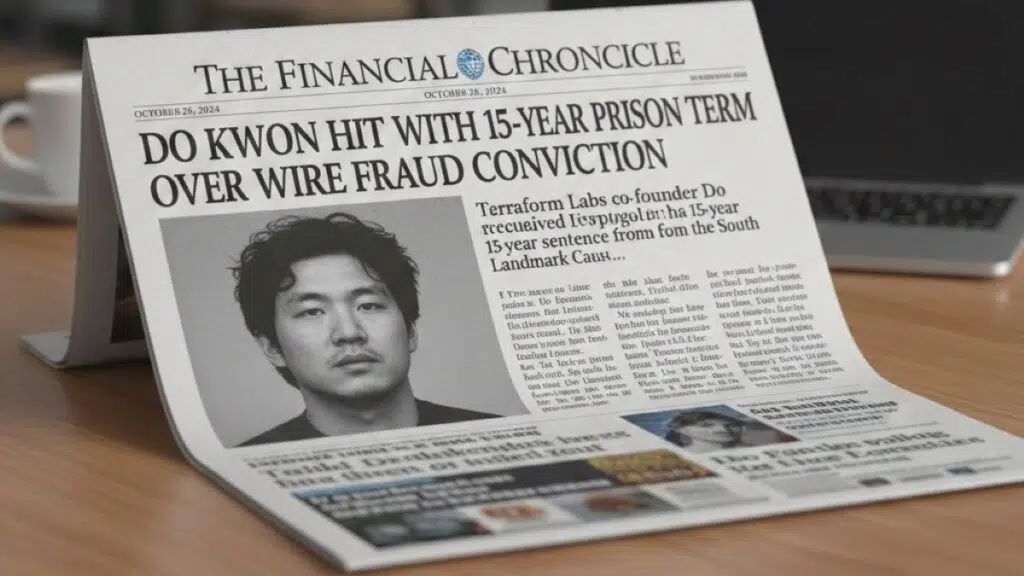
Do Kwon was sentenced to 15 years in U.S. federal prison this week, closing the American criminal case tied to the collapse of TerraUSD and the LUNA ecosystem. The ruling marks one of the most severe prison terms ever handed down in a crypto fraud case and reflects the scale of damage prosecutors said the Terra collapse inflicted on global investors.
Yet the sentence, while definitive in the United States, does not fully close Do Kwon’s legal exposure. South Korean authorities have made clear that domestic proceedings remain on the table. At the same time, parts of the crypto market reacted to the ruling in a familiar way: by pricing it, trading it, and even wagering on it.
The result is a story with three parallel tracks: a hard prison sentence, unresolved cross-border accountability, and a market culture that continues to treat enforcement outcomes as tradable events.
What the U.S. court actually punished
The U.S. case centered on what prosecutors described as systematic deception around how TerraUSD maintained its dollar peg. According to court filings, when TerraUSD briefly lost its peg in 2021, Kwon publicly claimed that the protocol’s algorithmic design had restored stability. In reality, prosecutors said, a third-party trading firm was used to support the price, contradicting public assurances about how the system worked.
Kwon pleaded guilty to conspiracy to commit fraud and wire fraud. At sentencing, the court emphasized both the duration of the conduct and the magnitude of investor losses tied to the TerraUSD collapse and the subsequent LUNA crypto collapse. Victim statements described wiped-out savings, abandoned retirement plans, and long-term financial harm.
The judge imposed a 15-year term. The sentence exceeded what some observers expected but was well below the decades-long maximums discussed earlier in the case. The sentence nevertheless places the Terraform Labs fraud case among the most consequential criminal prosecutions the crypto industry has faced.
>>> Read more: Do Kwon Guilty Plea in U.S. Fraud Case Over Terra
Why this still is not legally “over”
From a U.S. perspective, the criminal case is finished. Appeals aside, the sentence is final and enforceable. But international cases do not operate on a single track. The New York judgment has not extinguished Kwon’s exposure outside the United States.
South Korean prosecutors have long pursued their own investigation into Terraform Labs. They focused on alleged violations of domestic financial and capital markets law. Those charges are separate from the U.S. counts and rest on a different statutory framework. That distinction matters because it removes the common misconception that Kwon is shielded from further prosecution by double jeopardy principles.
In practical terms, the question is no longer whether South Korea has jurisdiction. It is whether and when it could realistically put Kwon on trial.
South Korea’s case follows a different legal logic
Korean authorities have framed their case around alleged violations of the Capital Markets Act and related statutes. Unlike the U.S. indictment, which focused on fraud against U.S. investors and markets, the Korean investigation emphasizes domestic investor harm and regulatory breaches under Korean law.
That difference explains why officials continue to describe a potential proceeding as a distinct case rather than a retrial. A Do Kwon South Korea trial, if it happens, would not revisit the U.S. verdict. It would assess whether the same conduct, or overlapping conduct, breached Korean financial law.
Some reports have suggested that a conviction in South Korea could theoretically result in substantial prison time. Others stress that any outcome would depend on how prosecutors frame the charges and whether they decide to move forward at all. What is clear is that the legal pathway is slower and more conditional than many headlines imply.
Extradition versus transfer: the realistic path to a second case
Despite frequent references to “extradition,” an immediate handover to South Korea is not how the process works once a U.S. sentence is imposed.
The more realistic mechanism is the international prisoner transfer system. Under this framework, a convicted person may apply to serve part of a sentence in their home country, typically after completing a significant portion of the original term. Reporting around Kwon’s plea indicates that U.S. prosecutors would not oppose a transfer request once eligibility thresholds are met.
That distinction matters. A transfer is not the same as extradition to South Korea, nor does it guarantee a new trial. It simply makes Kwon physically available to Korean authorities at a later stage, assuming approvals from both governments.
In other words, any second trial against Kwon in South Korea would be measured in years, not months. The U.S. sentence remains the controlling reality for the foreseeable future.
The third thread: betting on the verdict
While courts weighed prison years, parts of the crypto ecosystem responded in a way that has become increasingly familiar.
Prediction platforms listed markets allowing users to wager on how much prison time Kwon would receive. Polymarket’s listing offered ranges of possible sentences. After the ruling, the market resolved in favor of the highest bracket.
The existence of such markets does not affect the legal outcome. But it does highlight a persistent tension in crypto culture: enforcement actions are not only news events, but they are also tradeable narratives. In this case, a federal prison sentence became another data point to price, alongside token unlocks and macro releases.
The rise of crypto prediction markets has forced regulators and industry participants alike to confront uncomfortable questions about where speculation ends and accountability begins.
Token prices moved, as expected
Around the sentencing, Terra-linked tokens experienced bursts of volatility. LUNA and LUNA Classic both saw short-term price moves as headlines circulated, even though Kwon’s 15-year sentence has no direct bearing on the functionality or prospects of those networks.
The reaction fits a familiar pattern. Legal developments tied to prominent founders often trigger brief trading activity, even when they do not alter fundamentals. The moves say more about speculative reflexes than about any reassessment of the Terra ecosystem itself.
What this case ultimately represents
The Kwon saga now sits at the intersection of three realities.
First, enforcement has teeth. Do Kwon’s 15-year federal sentence sends a clear signal that crypto fraud cases can carry consequences comparable to traditional financial crimes.
Second, accountability remains fragmented across borders. The possibility of a second trial in South Korea underscores how global crypto projects can fall under multiple legal regimes, each moving at its own pace.
Third, market culture has not fully adapted to that reality. Even as courts impose long prison terms, segments of the industry continue to frame legal outcomes as speculative events rather than institutional milestones.
>>> Read more: Terraform Launches Claims Portal for Compensation
What to watch next
The next developments are procedural, not dramatic.
Observers should watch for formal moves by South Korean prosecutors, any filings related to transfer eligibility later in Kwon’s sentence, and potential civil actions aimed at asset recovery. Each step will clarify whether the legal story truly has a second act or whether the U.S. judgment remains the final word.
For now, the facts are straightforward. Do Kwon sentenced to 15 years is no longer a headline. It is a fixed outcome. Everything that follows will unfold slowly, under legal frameworks far less volatile than the markets reacting to them.