



TL;DR
- MiningOS expands Tether’s role in Bitcoin mining by introducing open-source software that reduces reliance on proprietary mining systems.
- The release reflects a broader infrastructure strategy, with Tether focusing on control, auditability, and long-term resilience in mining operations.
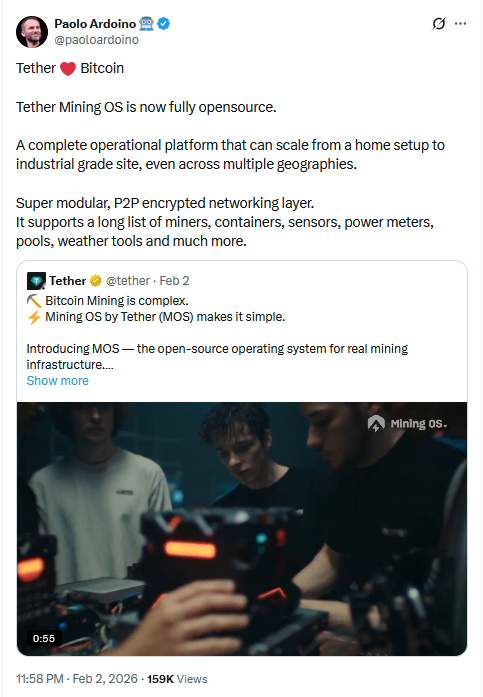
Tether has released an open-source operating system for Bitcoin mining, extending its involvement beyond capital deployment and into the software layer that runs mining operations. The move reinforces Tether’s growing role in Bitcoin mining and reflects a focus on operational resilience rather than short-term market disruption.
Branded as MiningOS, the system aims to reduce reliance on closed, third-party tools that dominate Bitcoin mining software today. Tether positions the release as a way to give miners greater visibility and control over their infrastructure while scaling its own mining activities.
Tether’s MiningOS: What Was Released
Tether’s MiningOS is an open-source operating system built to manage and monitor Bitcoin mining operations. It targets core functions such as device coordination, performance oversight, and system-level management, rather than mining pools or hardware manufacturing.
Tether describes the platform as open source mining software that operators can deploy across existing setups without forcing them into proprietary ecosystems. The company has emphasized compatibility with current mining environments, allowing miners to adopt the system without reworking their entire stack.
Why Mining Software Matters More Than It Appears
Mining hardware receives most of the attention in Bitcoin, but control often sits elsewhere. Bitcoin mining software determines how machines communicate, how performance is measured, and how issues are diagnosed in real time.
Much of the industry relies on proprietary mining software that limits transparency and restricts customization. These systems can create operational blind spots, especially at scale, where software failures or inefficiencies are costly and hard to audit.
By addressing this layer directly, MiningOS targets a part of the mining stack that shapes efficiency and risk, even though it remains largely invisible to outsiders.

How MiningOS Fits Tether’s Existing Bitcoin Strategy
Tether’s release of MiningOS aligns with its broader expansion in Bitcoin mining activities. The company has invested directly in mining operations and energy infrastructure, positioning Bitcoin as a long-term strategic asset rather than a peripheral holding.
As those operations grow, dependence on external vendors becomes a structural risk. Developing internal tooling, then releasing it publicly, allows Tether to standardize its own systems while contributing to the wider Bitcoin mining infrastructure ecosystem.
This approach frames MiningOS as part of a long-term operating strategy, not a standalone product launch.
Open Source as a Risk-Reduction Tool
Open-sourcing MiningOS changes the distribution of risk. With open source mining software, code can be inspected, audited, and improved without relying on a single vendor’s roadmap or priorities.
This also reduces exposure to vendor lock-in, where licensing terms or opaque firmware updates constrain mining operators. For large-scale miners, the ability to review and adapt software internally can lower operational friction. For smaller operators, it can reduce entry barriers tied to proprietary systems.
In both cases, open source functions as a practical control mechanism rather than a philosophical statement.
Broader Market Impact: Incremental, Not Disruptive
Tether’s MiningOS is unlikely to displace existing proprietary mining software in the near term. Switching costs remain high, and many operators value long-standing support relationships with established vendors.
Hence, adoption is more likely to be gradual. Early use may concentrate among operators that already prioritize customization and internal development. Over time, broader adoption will depend on stability, community contributions, and proven performance in live environments.
The Analytical Tension: Open Software, Expanding Influence
The release of MiningOS supports decentralized Bitcoin mining by lowering software barriers and improving transparency. At the same time, it places Tether deeper into the technical fabric of mining operations.
Open source does not confer control, but it does create influence through standards and adoption. Bitcoin’s history shows that such tools can coexist with decentralization, provided no single entity controls access or direction.
MiningOS sits within that balance. Its impact will depend less on who released it and more on how widely and independently it is used.
>>> Read more: Tether Stablecoin Faces Pressure and Reinvents Itself
What This Signals About Tether’s Direction
MiningOS signals a continued shift toward infrastructure-level participation. By contributing directly to Bitcoin mining infrastructure, Tether is reinforcing its role as an operational actor rather than a purely financial one.
This release does not change mining economics overnight. It does, however, underline how major firms are increasingly focused on the control layers that support Bitcoin’s network. In that context, MiningOS is less about disruption and more about durability.