


TL;DR
- Negotiations around the US crypto bill have stalled after major banks rejected a White House compromise on stablecoin yield rules.
- President Donald Trump urged Congress to pass the legislation, escalating tensions between banks and the crypto industry.
- The deadlock raises uncertainty about whether the crypto market structure bill known as the CLARITY Act can pass in 2026.
Efforts to pass sweeping cryptocurrency legislation in the United States have hit another obstacle as negotiations over a key digital asset framework stall in Washington.
The US crypto bill, widely associated with the Digital Asset Market Clarity Act framework, is facing renewed uncertainty. After weeks of consultations, major banking groups rejected a compromise proposal backed by the White House. The dispute centers on whether crypto platforms should be allowed to offer yield-like rewards to users holding stablecoins.
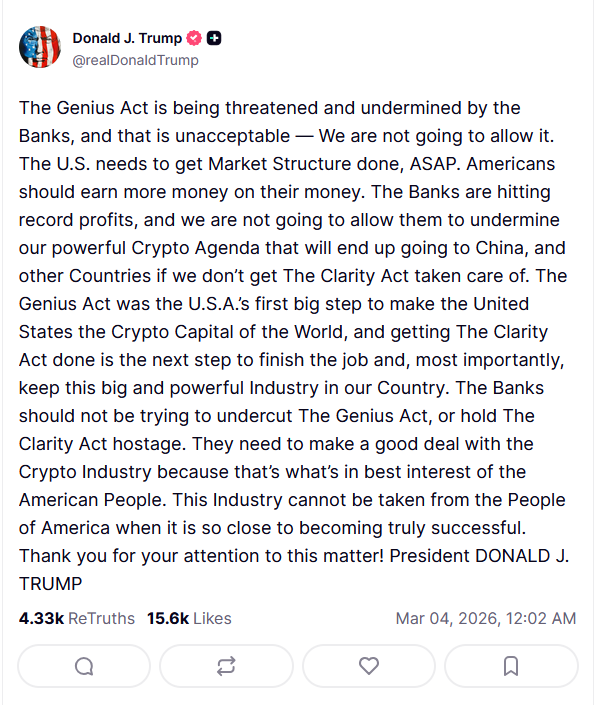
Now, President Donald Trump has stepped into the debate, criticizing banks for obstructing the legislation. He urged Congress to move forward quickly. The intervention has intensified an already complex political fight between traditional financial institutions and the crypto industry over how digital assets should be regulated.
Stablecoin rewards at the center of the dispute
The latest impasse stems from failed White House consultations over stablecoin rewards. Banks rejected compromise proposals ahead of a March 1 deadline.
Stablecoins are digital tokens pegged to fiat currencies, such as the U.S. dollar, widely used for trading and payments in crypto markets. Under the GENIUS Act passed in 2025, issuers must back stablecoins 1:1 with high‑quality reserves and provide regular disclosures. However, the debate now centers on whether exchanges and platforms can offer yield‑ or reward‑like incentives on stablecoin holdings or transactions.
Banking groups strongly oppose such provisions. They argue that they would let uninsured stablecoin balances compete with FDIC‑protected bank deposits for customer funds. Industry representatives warn that yields comparable to savings rates could redirect trillions in liquidity from banks over time, threatening lending capacity. Crypto firms counter that activity‑based rewards expand payment use cases and promote competition with traditional finance.
Trump intensifies pressure on banks
The political dimension of the debate escalated after President Trump publicly criticized banks for blocking the legislation.
Reports indicate the president met privately with Coinbase CEO Brian Armstrong before posting comments accusing banks of attempting to undermine his administration’s crypto agenda. Trump called on lawmakers to pass the legislation quickly, framing the issue as part of a broader effort to modernize the U.S. financial system.
His remarks helped fuel renewed attention around the US crypto bill. The legislation has been under negotiation for months as lawmakers attempt to balance innovation with financial stability concerns. Despite Trump’s support, analysts note that presidential pressure alone may not be enough to break the current stalemate, particularly given the competing interests involved.
>>> Related: White House Crypto Talks Continue as March 1 Deadline Nears
Market reaction boosts crypto assets
Financial markets responded positively to the political developments.
Bitcoin climbed following Trump’s comments supporting the legislation, briefly moving toward new highs for the year. Crypto-related equities also rallied, with companies tied to digital asset infrastructure and mining posting gains.
Investors often view progress toward clear regulation as a positive catalyst for the industry. Supporters of the legislation argue that a comprehensive regulatory framework could reduce legal uncertainty and encourage greater participation from traditional financial institutions.
At the same time, market analysts caution that the legislative process remains unpredictable and could take months to resolve.
Legislative timeline remains uncertain
The US crypto bill, formally the Digital Asset Market Clarity (CLARITY) Act, cleared the House with bipartisan support in 2025. Nevertheless, the Senate remains stalled on key provisions. Lawmakers must resolve disputes over stablecoin rewards, market oversight, financial crime compliance, and jurisdictional lines between the SEC and CFTC. With the 2026 midterm elections looming, the window to advance this financial legislation is narrowing.
Industry observers remain cautiously optimistic that talks between representatives of the banking and crypto industries could resume soon to find a compromise, potentially unlocking Senate progress. Still, the recent breakdown underscores persistent tensions blocking comprehensive digital asset regulation.