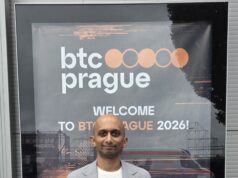


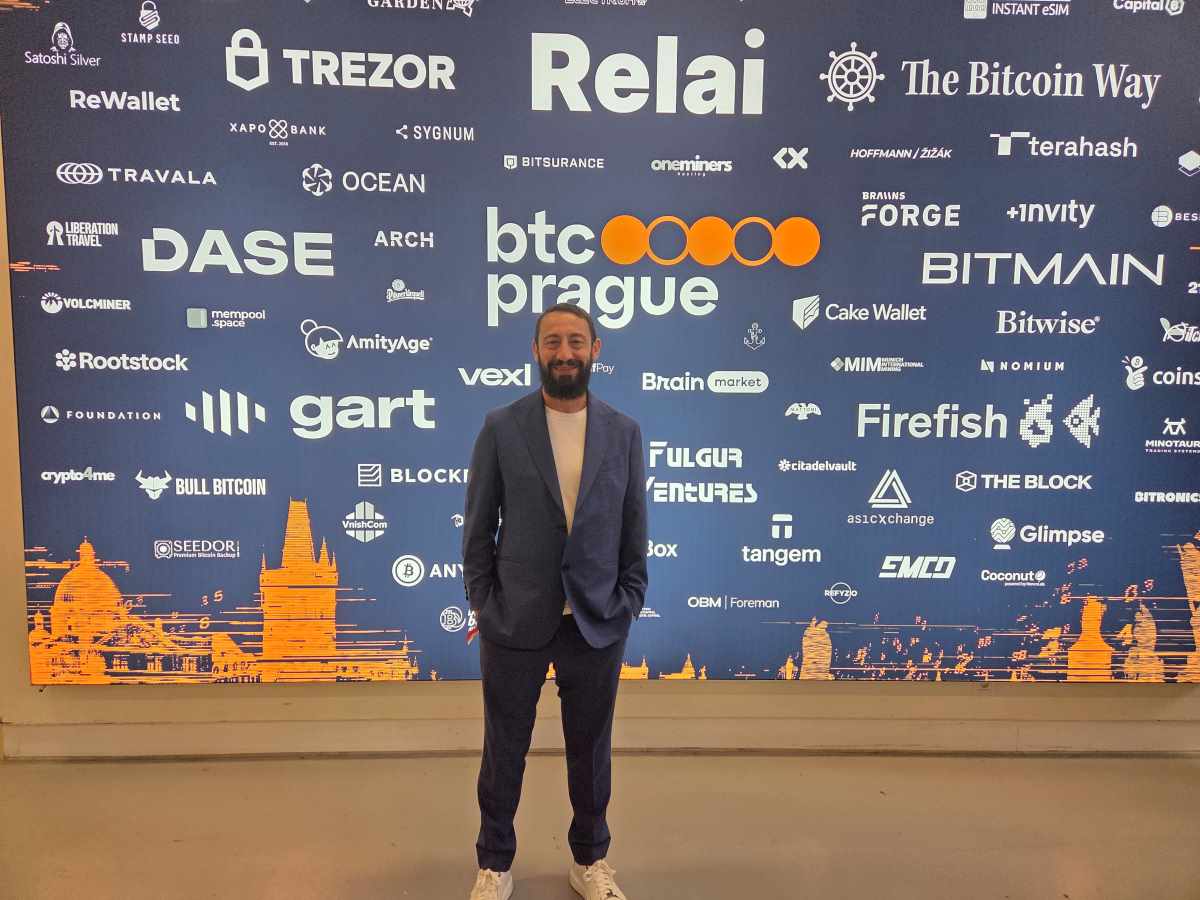
Luca Esposito has become a familiar face on the Bitcoin conference circuit. He is moderating panels, speaking on stages from Dublin to San Marino, present wherever the conversation turns to institutional adoption. Spend thirty minutes with him, and the recurring presence starts to make sense. We caught up with him on the sidelines of BTC Prague 2026
Luca wears two hats: one at Plan ₿ Network, the global Bitcoin adoption initiative born out of Lugano, Switzerland, and another at Blockstream Capital Partners, the institutional investment arm of one of Bitcoin’s most consequential infrastructure builders. His official title, Head of Expansion for EMEA and APAC, covers more ground than most people cover in a lifetime. But underneath the titles and the geography, Luca Esposito has essentially one job: teaching.
From Oracle to Satoshi
Before Bitcoin, there was a very different kind of career. Twenty-two years of it, in fact, were spent at Oracle, Microsoft, and Nuance, managing European teams tasked with bringing digital transformation to the financial sector. It is, as we pointed out to him directly, not a very Bitcoin-original background.
He laughed at that. Then he explained why it’s exactly the right one.
“The key to bring innovation in the sector is to find ways to interconnect with legacy systems and to bring the added value that these organizations are looking for,” he said. “For any new technology to be successful and being adopted to large institutions, the best way is to find an integration path with existing applications or technologies used by those financial institutions. And this is what I’m trying to do with Bitcoin.”
The pivot began a decade ago, when he started exploring blockchain as an angel investor and startup mentor. But the real turning point came seven years ago, when he read the Satoshi white paper.
“That’s where I kind of understood all my investments and interest in the blockchains, although it has been a very useful experience and very educational, it led me to the point to understand that Bitcoin was the type of chain to be used not only as a monetary alternative but as a global financial infrastructure.”
The blockchain world, in other words, was his education. Bitcoin was the conclusion.
He lives in Lugano. Four and a half years ago, he walked into the Plan ₿ Forum, the annual Bitcoin conference organized in partnership with the municipality, and found his community. He met figures like Giacomo Zucco and his wife Mir, started collaborating, and began building. In November 2024, he left Microsoft. In September 2025, he joined Blockstream Capital Partners as Head of Expansion for EMEA and APAC.
“I decided to dedicate the rest of my career to Bitcoin and the Bitcoin sector,” he said simply.
Two Roles, One Mission
The dual mandate he carries is, on the surface, a study in contrast. Plan ₿ Network operates at the level of cities and communities: merchants, municipal payments, free education courses for ordinary citizens. Blockstream Capital Partners operates at the level of pension funds, institutional allocators, and capital markets infrastructure.
A city treasurer and a pension fund CIO are not the same conversation.
“Those are two completely different sectors, two completely different playing fields,” he acknowledged. “We need both.”
But here’s where the educator in him surfaces. Whether he’s talking to a local government or a global financial institution, the approach is identical: start with knowledge.
“We always start with education. Knowledge is the key to understanding why Bitcoin should become part of, for example, a portfolio diversification. Why a pension fund should maybe look into allocating 1%, 2%, 3%, 5%. And then from there, we kind of guide the institution to understand what are the risks associated with that.”
From someone with his institutional pedigree, it might sound unusual but plainly put: “Yes, it’s an educational mission.”
In Lugano, that education is embedded in the fabric of daily life. Over 400 merchants now accept Bitcoin. Citizens can pay taxes to the municipal system in Bitcoin. There are free courses for residents. There is a physical hub, a PoW Space, where people gather not just to talk about Bitcoin but to build businesses around it. A new hub recently opened in Turin. One is coming to El Salvador. There is already one in Tokyo.
“We are heading towards some sort of a blueprint of how, not necessarily you make a Bitcoin city or a Bitcoin country, but how do you integrate this new network into the fabric of society,” he said.
Is Fiat Failing?
One of his panels at BTC Prague carries a title designed to provoke: How to Profit When the Fiat Experiment Fails. We pushed back a little on the word “fails”, noting that the fiat system as we know it today only began when Nixon ended the gold standard in 1971. So, this experiment hasn’t been running as long as many people might think. It’s been only fifty-five years, to be precise, not centuries.
His response was more nuanced than the panel title suggests. He went straight to the meaning of money itself; not in apocalyptic terms, but in philosophical ones. At its core, money should allow two people to exchange value privately, and it should allow them to retain that value over time.
It has failed society because it has not allowed for people to retain the value in time. This is the most important aspect of money. It has to allow people to retain value in time. Because that’s the only thing we all have in common. We have a very limited time on this planet.
Bitcoin’s fixed supply of 21 million, its mathematical scarcity, is where he plants his flag. And then he admits the obvious: the panel title was always meant to provoke.
“I’m not all doom and gloom about, oh, it’s going to fail, the big crisis, hyperinflation. I don’t think we’re going to get, I mean, it’s going to happen gradually, but it’s not going to be dramatic.”
What he sees instead is a slow, multipolar transition. Some parts of the world might return to gold standards. Others may embrace tokenized real estate. Others choose Bitcoin. Not a crash. A migration.
“In 50 years time, a point where the general wisdom will understand Bitcoin, because it’s finite and because it’s a complex adaptive system that is following the law of nature; then we’ll gradually and naturally transition and become a standard. So it would be the Internet of Values.”
Bitcoin vs. Everyone Else
His second panel, Building Capital Markets on the Bitcoin Layer, puts him in a more technically contested space. We put the challenge to him directly: TradFi institutions trust infrastructure they’ve used for decades. Besides, Ethereum already hosts over 65% of tokenized real-world assets. BlackRock is building on Ethereum, not on Liquid. So why Bitcoin?
His answer reached back, all the way back to the early internet.
In the early days of the web, he reminded us, there were more than 60 competing internet protocols. Every major company, his former employer Microsoft included, wanted its own. For a while, they competed. Then optimization took over, and the market converged on one: TCP/IP.
“Why did it happen? Because it was the most open, the most resilient, and the most adoptive.”
He sees the same dynamic playing out now, in a different form. The other cryptocurrencies, the smart contract platforms, the layer-2 experiments, they are all, in his view, attempts to prove there is something better than Bitcoin. But they all derive from it, in one way or another. And the market, he believes, is beginning to understand this.
Once you find mathematical perfection, anything that is a copy of it is, per definition, imperfect.
The more pointed argument is about infrastructure trust. You can tokenize real-world assets on Ethereum or on Solana, of course. But you are then dependent on a network that has a CEO, venture capital backing, and centralized points of failure. Bitcoin has none of those.
“The question is, on which protocol and global infrastructure do you want to tokenize your real-world asset, your dividends, your bonds. On the most anti-fragile one, which has more than 100,000 nodes, which cannot be confiscated, cannot be blocked?”
He was careful to distinguish between distributed and decentralized because he clearly considers this distinction critical. Ethereum may present itself as decentralized, he said, but it is, in his view, distributed. Not the same thing.
We left it there.
The Banks Are Coming
Perhaps the most surprising part of the conversation was his view on banks. In a Bitcoin conference, saying something generous about the banking system is a mildly radical act. He said it anyway.
“Banks, they are in the fabric of society for hundreds of years. They are part of the DNA of society. We cannot deny that.”
But his generosity has an edge. The role banks could play in financial literacy, explaining Bitcoin, distributing it, integrating it, is enormous. They are not playing it. Or, in his words, “they are playing it very selectively.”
What has changed, he says, is MiCA, the EU’s Markets in Crypto-Assets regulation. For all the Bitcoin community’s ambivalence about regulatory frameworks, he’s clear-eyed about what it unlocked.
“This sector needs to be regulated, otherwise they can’t do it. Because they don’t want to get in trouble. Now they have MiCA, now they have some bandwidth within which they can operate. And we are having conversations with all these banks because of MiCA. Before it was all about going to an aperitivo or going to an event, chatting, very curious. But that was it. Now, we are really working with them to see how we can integrate Bitcoin data in a compliant way.”
The first team you talk to at any bank, he noted, is the compliance team. That used to be the end of the conversation. Now it’s the beginning.
General Wisdom
We closed by asking him what it would take for him to feel that the world had finally understood Bitcoin. A specific city, a specific institution, a specific deal? What would it take for Bitcoin to stop being seen as a threat and start being seen for what he believes it really is: an evolution of our societal systems.
He paused. Asked us to repeat the question. Then answered with the same word he’d used throughout the entire conversation – education.
“It needs to become general wisdom. Again, general wisdom happens with a lot of education. I’m sorry to be boring, but unfortunately, “study Bitcoin” is a mantra that is not just a tagline. It really means it.”
Studying Bitcoin, he was careful to add, doesn’t mean learning how to run a node or read a block explorer. Bitcoin is multidisciplinary. You can approach it through economics, through philosophy, through personal finance, through history.
“Study Bitcoin really means to get deep into what this big change is going to bring, not only to society, not only to the economic sector, but to yourself as a person. Because it pushes you to ask very fundamental questions. Why am I working so hard, and then 20 years later I have less than before? Why my grandmother had a pension which had a really good lifestyle 30 years ago, and now I have to give her money to survive?”
Once it arrives, we will see the shift from two directions simultaneously: individuals who study their way to understanding, and institutions that finally align their commercial interests with the opportunity in front of them.
It’s not going to be through a revolution that we’re going to change. It’s going to be through an optimized competition of the assets.
Optimized competition. Coming from a man who spent 22 years inside the corporations that will eventually have to make that choice, the phrase carries a certain weight.