



TL;DR
- Tether’s reserve buffer fell from $8.23 billion to $4.11 billion in Q2 2026 despite reporting $1.5 billion in operating profit.
- Most of the decline came from falling gold and Bitcoin prices and a $2.38 billion reduction in secured loans.
- USDT remained fully backed, but the smaller buffer raises questions about how excess reserves are managed.
Tether, the company behind USDT, the world’s largest stablecoin, said its reserves exceeded its liabilities by $4.11 billion as of June 30, 2026. Three months earlier, Tether’s reserve buffer stood at $8.23 billion. The company earned about $1.5 billion in operating profit over the same quarter, as attested by the accounting firm BDO.
A stablecoin like USDT is supposed to trade at $1 because it is backed by reserves, cash, government bonds, gold, and other assets worth at least as much as the tokens in circulation. On that count Tether’s $187.75 billion in total assets still comfortably clears its $183.64 billion in liabilities, most of which is simply the value of USDT tokens people hold. What shrank is the cushion above that baseline. Those excess reserves would absorb losses if reserve assets fell in value or a large number of holders tried to redeem USDT at once. So, the size of that padding is what determines how much stress the system can take before the peg itself comes under pressure.
While Tether’s press release did not explain what drove the buffer down from $8.23 billion, lining up this quarter’s reserve report against last quarter’s fills in most of the gap.
Where the $4 billion went
| Category | Q1 (Mar 31) | Q2 (Jun 30) | Change |
|---|---|---|---|
| U.S. Treasury bills | $117.04B | $114.96B | -$2.08B |
| Reverse repos | $24.08B | $25.62B | +$1.54B |
| Gold | $19.84B (132.2 tons) | $18.84B (146.2 tons) | -$1.00B |
| Bitcoin | $6.62B (~97,137 BTC) | $5.80B (98,933 BTC) | -$0.82B |
| Secured loans | $15.83B | $13.45B | -$2.38B |
| Total assets | $191.77B | $187.75B | -$4.02B |
The Treasury and repo book, the core of the reserve, barely moved on net. Two things account for nearly all the rest.
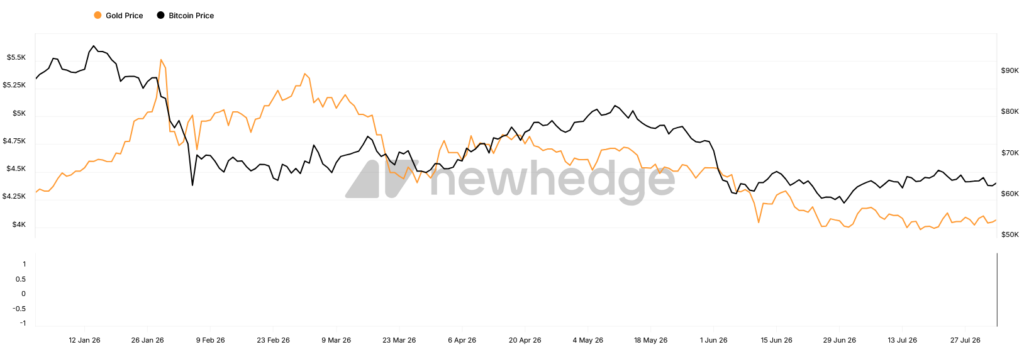
Gold and Bitcoin lost value on paper even as Tether bought more of both. The company added 14 tons of gold and about 1,796 Bitcoin during the quarter, but gold fell around 15% and Bitcoin dropped from roughly $68,200 to $58,600. Buying into a falling market meant the new purchases only partly offset the markdown on everything already held, leaving a combined $1.82 billion paper loss on assets Tether still owns in full.
Secured loans dropped by $2.38 billion, exactly the reduction Tether disclosed. This is the one line where money actually left the reserve, not just lost value on paper. Add the $1.82 billion in mark-to-market losses to the $2.38 billion loan reduction and the total, $4.2 billion, comes close to accounting for the entire $4.02 billion decline in Tether’s reserve buffer. The residual difference likely sits in smaller categories, public equities and other investments. Tether’s Q2 release does not break out those individually.
The murkiest line item
Secured loans are the part of Tether’s reserve that draws the most scrutiny, because nothing else in the report works this way. Tether values gold, Bitcoin, and public equities at current market prices every quarter. Movements in that section reflect the market. Secured loans are measured differently, at the loan’s face value under standard accounting rules. They are adjusted only if Tether books a credit loss. That means this quarter’s $2.38 billion decline is not Tether marking down the loans because borrowers’ collateral lost value. It reflects an actual change in principal outstanding, loans being repaid, called in, or not renewed.
Who borrows
Tether has never disclosed who receives these loans. Borrowers post collateral, historically crypto assets like Bitcoin, worth more than what they owe. Tether can seize that collateral if a loan isn’t repaid or the coverage ratio slips. Outside reporting has linked some past borrowers to now-defunct firms including Celsius Network and Three Arrows Capital, based on blockchain analysis, not anything Tether confirmed. In 2022 Tether pledged to wind this category down to zero by the end of 2023. It never happened; the balance dipped, grew again, and has sat in the multiple billions ever since.
There is a plausible link between this quarter’s loan reduction and the same price declines that hit gold and Bitcoin. If a borrower posted crypto as collateral and its value fell, Tether could have issued a margin call requiring the borrower to repay part of the loan to keep the required coverage intact. That would show up exactly as a drop in the secured loans balance, just triggered by the borrower’s collateral, not a markdown on Tether’s own books. Nothing in the disclosure distinguishes that scenario from Tether simply choosing to lend less this quarter, and the company has never said which it was.
>>> Read more: How Tether Commodity Lending Is Reshaping Trade Finance
An attestation, not an audit
BDO’s report is an attestation, a check of Tether’s figures against a defined set of criteria on a single date. A full audit digs into a company’s complete financial records and internal controls over an extended stretch of time, not one snapshot. Tether has said a “Big Four” audit is underway but has not said when it will conclude.
That audit is the only mechanism that could settle whether this quarter’s $2.38 billion loan reduction was Tether pulling back from risk or Tether forcing borrowers to repay as their collateral lost value. Tether has not said which it was, and until the audit finishes, no one outside the company can check.