


TL;DR
- Attackers used OpenClaw branding on GitHub to trick users into connecting wallets to phishing sites.
- The scam relied on fake token incentives and user-approved permissions to enable fund theft.
- The incident highlights growing risks at the intersection of AI platforms and crypto wallet security.
A phishing campaign exploiting the growing visibility of OpenClaw is raising new concerns about how quickly emerging AI platforms can become targets for crypto-related attacks. The theft campaign uses fake token incentives and GitHub-based social engineering to trick OpenClaw users into connecting their wallets to malicious infrastructure.
This approach mirrors a familiar pattern in crypto scams. But the use of developer platforms and AI branding marks a clear shift in targeting strategy.
GitHub phishing campaign targets developers
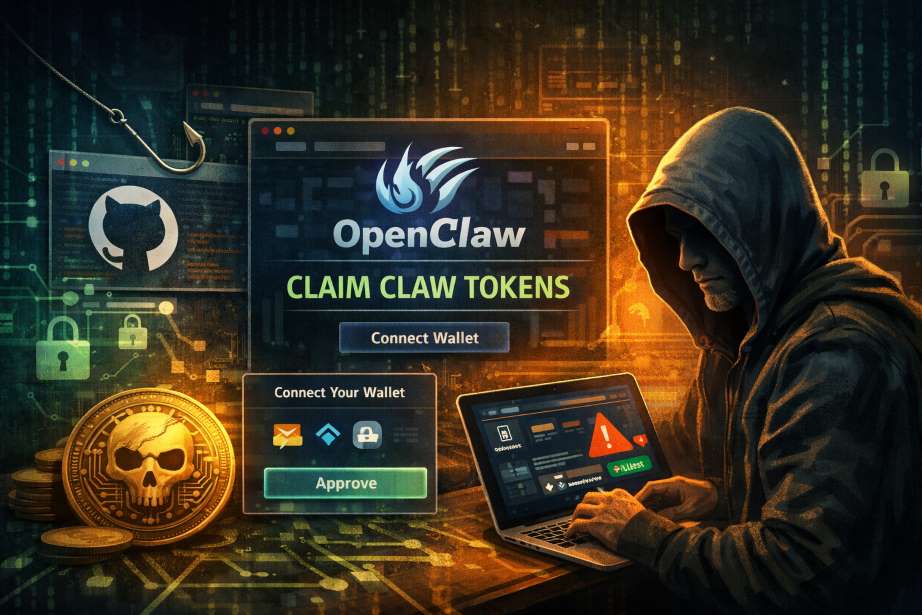
At the center of the incident is a coordinated effort to impersonate OpenClaw across GitHub. Attackers used fake accounts to post issue comments and engage with users who interacted with OpenClaw repositories, directing them to phishing pages designed to steal funds from connected crypto wallets.
Victims were offered up to $5,000 in “CLAW” tokens. The message then linked to a cloned OpenClaw-style website. Once there, users were prompted to connect their wallets to claim the tokens. Approving access exposes permissions that allow attackers to execute transactions without further interaction and drain the crypto wallet.
This is a simple setup, exploiting user trust with a classic fake token scam. It works because it looks legitimate.
How the OpenClaw wallet theft scam works
Technically, the mechanism is straightforward and relies on user-approved wallet permissions, not direct system compromise.
Analysis of the phishing infrastructure revealed obfuscated JavaScript designed to hide its function. In several cases, a script labeled “eleven.js” handled wallet interaction logic.
Once a wallet connection is initiated, the script can request approvals or trigger transactions that enable asset transfers. Some versions even clear browser storage to remove traces of the interaction.
This is not a sophisticated exploit. It does not need to be. The attack succeeds if the user approves the request.
At the time of reporting, no confirmed financial losses were publicly documented. Still, the infrastructure was active and ready to be used.
No official token, but repeated crypto bait
OpenClaw is not a crypto project and does not have an official token. Project leadership has repeatedly warned that any “CLAW” token is not legitimate.
Even so, attackers continue to reuse the same narrative. The promise of early rewards taps into familiar crypto behavior, where users expect incentives tied to new platforms.
This gap between official messaging and user expectations is a key security risk for OpenClaw users because it gives attackers a reliable entry point.
The tactic is not new. The delivery method is.
Why AI agent ecosystems are becoming a new risk layer
More broadly, the incident exposes growing concerns about how AI agent ecosystems can create new crypto-related security risks. Separate research has identified hundreds of potentially malicious third-party tools within the OpenClaw ecosystem.
These tools can interact with wallets, APIs, and external systems. That expands the attack surface significantly.
The phishing campaign itself operates outside the platform. But the pattern is consistent. Rapid ecosystem growth is outpacing security controls.
For users, the risk is no longer isolated to exchanges or DeFi apps. It now extends into experimental tools and automation layers.
>>> Read more: Cardano Wallet Phishing Uses Fake Eternl Desktop Installer
What this means for crypto users
The incident highlights a shift in how crypto scams are delivered. Attackers exploit OpenClaw’s branding, pushing users to wallet approvals that expose them to theft. Bad actors no longer rely solely on email or social media. They are embedding themselves inside developer environments and trusted platforms where people are more likely to engage and less likely to question legitimacy.
But the core rule remains unchanged. Wallet connection requests carry real risk. A single approval on a malicious interface can lead to irreversible loss. As AI platforms continue to integrate with blockchain tools, that risk will only grow. The boundary between experimentation and financial exposure is getting thinner.
In this environment, a wallet approval is not a minor action. It is a direct financial risk.