


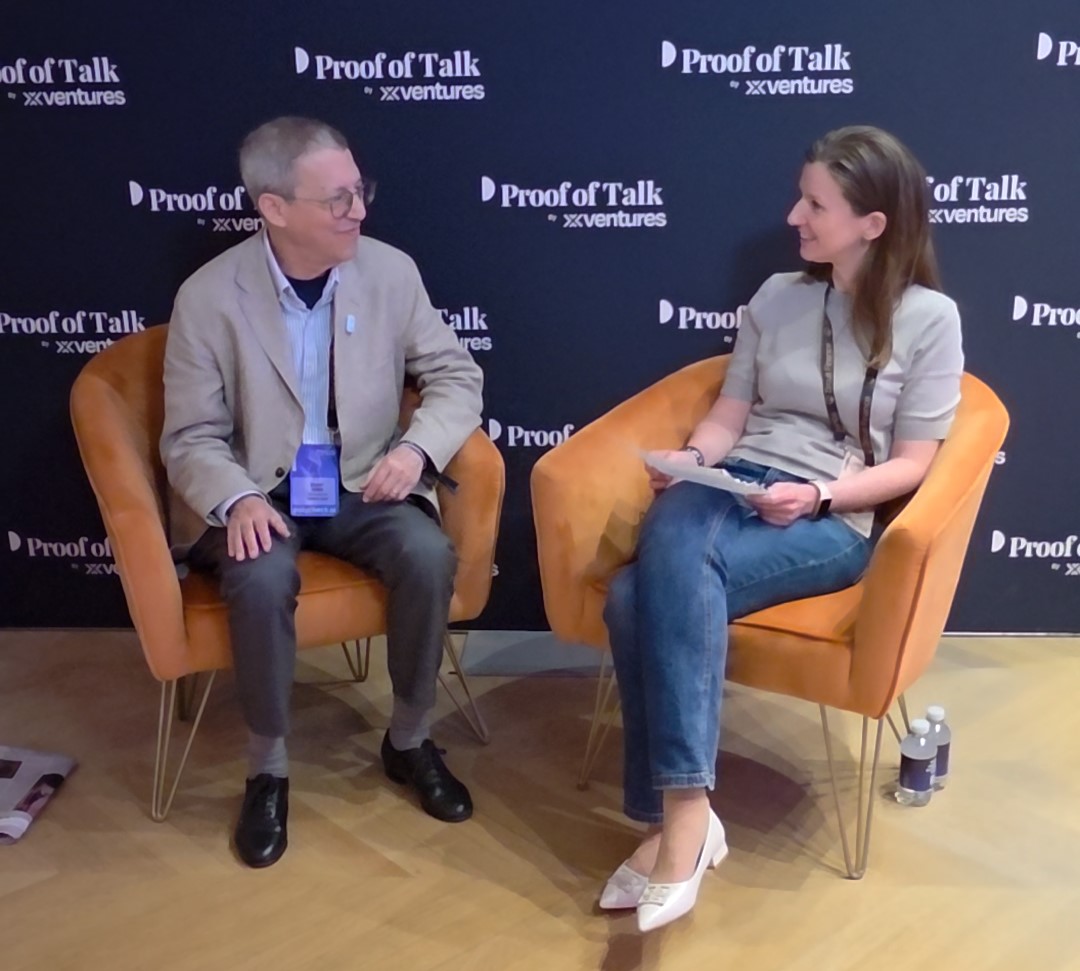
Stuart Haber walked into the interview carrying a copy of the New York Times. Not as a prop, exactly, more as evidence. Tucked inside that Sunday edition, as it has been every week since 1995, is a small classified ad. Most readers scroll past it. But what it contains is a cryptographic hash, a compact digital fingerprint, that encapsulates every record registered on the world’s oldest continuously running blockchain in the preceding seven days. A blockchain that Haber and his partner W. Scott Stornetta launched before any of us even heard of Satoshi Nakamoto or Bitcoin or Ethereum.
“Still running,” Haber said, setting the paper down. “With a weekly ad in the national edition of the New York Times.”
That detail, this analog anchor for a digital trust system, tells you almost everything about how Stuart Haber thinks. He is the Chief Cryptographic Officer of SureMark Digital, co-inventor of the blockchain, and and one half of the most cited duo in the Bitcoin white paper. He has been solving the same problem for 35 years, and he is still not done.
It Was Never About Money
Fall 1989. Bellcore, the Bell Communications Research lab in New Jersey. Haber had been there two years when Scott Stornetta arrived with what he believed was an urgent and unsolved problem. The world was going online. Every record, financial, legal, creative, medical, was becoming a string of bits. And a string of bits, unlike a physical document, carries no inherent proof of when it was created or whether it has been altered.
“We were worried about all of the world’s records,” Haber said. “We were not trying to invent electronic money.”
There was already a stream of cryptographic research into digital currency. Haber and Stornetta went a different direction. Their solution, now known as the blockchain technique, was designed to register any digital record and prove its existence. Prove the integrity of a contract, a creative work, a financial transaction without relying on any single trusted authority. The duo published its first paper, How to Time-Stamp a Digital Document, in 1991. Experimental code followed the same year. By 1995, their spin-out company Surety had deployed the first commercial blockchain, anchoring it weekly in the New York Times.
Satoshi Nakamoto cited their work three times in the Bitcoin white paper, more than any other source. The data structure at the heart of Bitcoin, the chain of hash-linked blocks with Merkle trees, is theirs. Satoshi adopted it directly. Though he narrowed its application to financial transactions. He added the proof-of-work consensus mechanism, and launched a revolution. Haber describes watching that unfold as “an amazing thing to watch” — gracious, precise, and carefully short of triumphalist.
The Trust Problem Has Not Been Solved
Today, the institutions most aggressively deploying blockchain infrastructure are the same ones Haber and Stornetta built the technology to make unnecessary. BlackRock. JPMorgan. The European Central Bank. Asked whether institutional blockchain represents progress or regression, whether we are simply rebuilding the same trust hierarchy on a new technical stack, Haber does not flinch, but he does not fully commit either.
“Bitcoin is still a pretty large sum of money represented and Bitcoin is not run by a single institution,” he said. On everything else, tokenization, institutional DeFi, central bank digital infrastructure, he offered the same two words twice in the same conversation: “We’ll see.”
That restraint is not evasion. It is the considered position of someone who spent months in 1989 and 1990 trying to prove that a trusted-party-free integrity system was mathematically impossible; before realizing the answer was not mathematical at all.
“It was by stepping back and thinking of the social setting,” he said. “What does it mean, as a human assertion, that this document existed in the world at this time?” Reframing the question from cryptographic puzzle to social question led directly to the concept of decentralization. And the answer was widespread verifiability, not institutional authority. It is still the answer. Whether the industry building on his foundations agrees is, as he says, yet to be seen.
Making Deepfakes Irrelevant
The sharpest and most immediately useful thing Stuart Haber said at Proof of Talk had nothing to do with the 1990s. It had to do with a video call in Hong Kong, in January 2024.
A mid-level employee at a multinational firm received an order to wire approximately $25 million to an overseas account. The employee was appropriately suspicious and requested proper authority. A video call was arranged. Several senior executives from the company joined, all confirming the instruction. Every single one of them was a deepfake! The employee wired the money and the firm lost $25 million.
That attack was the design inspiration for SureMark’s flagship product, SureCircle. SureCircle’s answer to deepfake fraud is not detection, but circumvention.
We make deepfakes irrelevant by sidestepping the problem.
The mechanism is a cryptographic challenge-response system. Each executive, board member, outside counsel, or high-authority contact in a company holds a SureMark credential. In cryptographic terms, the credential is a public key from a public-private key pair. Before authorizing any significant transaction or instruction, a real-time challenge is issued. Only the holder of the corresponding private key can meet the task. A deepfake, however sophisticated, cannot respond to the cryptographic challenge because it was never given the key to answer it.
“If that firm were a SureMark customer,” Haber said of the Hong Kong attack, “the scam would have been avoided.”
SureMark’s second product, Verified Web, extends the same logic to published content. The author of any piece of content, an article, a video, a podcast, can cryptographically sign the work, and participants can co-sign, too. What you get is a publicly verifiable chain of authenticity. Haber offered, on camera, to co-sign this interview. The invitation stood.
On Regulators Who Don’t Know What They Don’t Know
The regulatory frameworks now taking shape around tokenized assets, MiCA in Europe, the emerging digital asset rules in the United States, are beginning to require verifiable audit trails, identity attestation, and provenance records. In theory, that is exactly what cryptographic time-stamping wanted to deliver. In practice, Haber is cautious.
There are people in positions of authority for writing regulations who don’t know what they don’t know.
He is not dismissive. He allows that there is a chance things get done right. But he frames compliance as a game. Institutions will push the envelope, satisfy requirements as minimally as possible, and the difference between cryptographic security and a convincing simulation of it might become visible only when something goes wrong. Institutional finance is moving fast, regulation is moving slower, and the gap is where the risk lives. Haber seems at peace with that, in the way that only someone can afford to be who has been right for 35 years before the world caught up.
Still Running
SureMark Digital is early-stage. Eleven people. First institutional funding round closed in August 2025, co-led by Two Small Fish Ventures. Their first major commercial partnership is with a cybersecurity practice whose insurers are actively recommending SureMark to clients as a mitigation tool against AI-driven fraud. It’s a meaningful signal that the market is beginning to price this risk seriously.
But the company that matters most to understanding Stuart Haber is not SureMark. It is Surety, the blockchain he and Stornetta launched in 1995. Still running, still publishing its weekly hash in the New York Times, still proving, to anyone who knows to look, that a document was real, and that it existed, and that it has not been changed.
He brought the newspaper to Paris to show it off, just in case the conversation went in the right direction.
It did.