


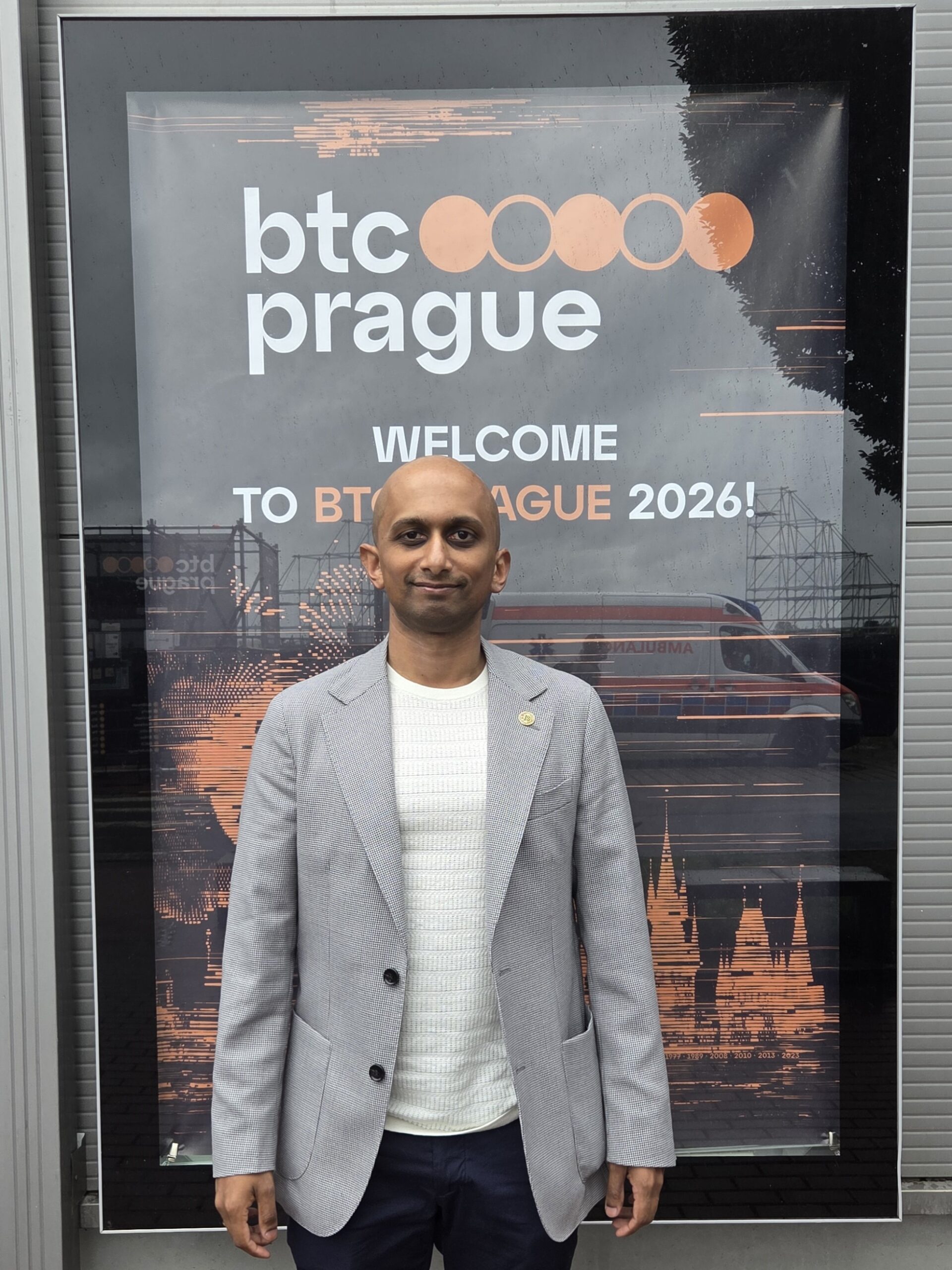
The conference halls of BTC Prague hum with the kind of energy that makes you feel like you’ve stumbled into a gathering of true believers. And perhaps you have. Amid the noise, Stephan Livera cuts a calm, measured figure. He speaks the way he podcasts: clearly, deliberately, without wasted words. He has been doing this long enough to know exactly what he thinks.
Livera didn’t come to Bitcoin through speculation or a lucky early trade. He came through books. Specifically, the works of 19th-century Viennese economists who argued that sound money, money that cannot be inflated away by governments, is the foundation of a free society. When he eventually encountered Bitcoin, it simply made sense.
“For me, it was mainly my interest in libertarian ideas and Austrian economics,” he says. “Being anti-central banking, anti-fiat money. So that was something I was interested in even at a teenage age. And then when I saw Bitcoin and I realised what it was, that’s when I really doubled down.”
He had been working as a Chartered Accountant with stints at Deloitte, the Commonwealth Bank of Australia, Macquarie Group. Good jobs by any measure. But something didn’t sit right. The financial system he was working inside was, in his view, fundamentally broken. Bitcoin offered an exit.
“I was basically shouting from the rooftops about Bitcoin for a while,” he says, with a smile that suggests he is only slightly exaggerating. “And I was frustrated about the quality of the media and the education at the time. So I started my podcast in 2018.”
Seven Hundred Episodes Later
The Stephan Livera Podcast now sits at over 700 episodes and 6 million downloads, ranking in the top 0.5% of podcasts globally. It has featured everyone from core Bitcoin developers to economists, miners, investors and philosophers. But Livera doesn’t talk about the numbers much. What he cares about is the conversation.
“A lot of people still don’t understand the right questions to even ask about Bitcoin,” he says. “What it really does for the world.”
The world he is describing has changed dramatically since 2018. Back then, he remembers having to explain what fiat money even meant. Today, nation states are buying and holding Bitcoin. Sovereign wealth funds are circling. The biggest wealth managers on the planet are offering Bitcoin ETFs. The education battle, at least at the macro level, has been largely won.
“Nowadays, it’s almost like people just kind of understand. Okay, that’s what fiat money is, Bitcoin is a different thing,” he says. “Those are some of the things that have really shifted.”
But a new challenge has emerged in its place. The age of the 90-minute deep-dive podcast is competing with the age of the 15-second scroll. “The attention span has kind of dropped,” Livera observes, with the air of someone who has made peace with an inconvenient reality. “So I just see my job as trying to help people learn about what’s interesting in Bitcoin; whether that is something technical, whether it’s new Layer-2s, whether it’s about treasury companies or lending or protocol or Bitcoin culture. These are all things I see as my remit to cover.”
Who Owns Bitcoin’s Future?
BTC Prague’s debate stage posed a confrontational question this year: Cypherpunks vs. Institutions — Who Owns Bitcoin’s Future? It is a question that carries particular weight when asked of Livera. He built his reputation on grassroots Bitcoin education. But he has also spent years as Managing Director of Swan Bitcoin International, a platform that has actively courted institutional capital and partnered with Tether. He does not see a contradiction.
Bitcoin is the money of enemies. You can’t stop your enemy from adopting it.
“I think it was inevitable,” he says. “If Bitcoin is the better money, everyone is going to adopt it.” He reaches for a quote from his friend, economist Saifedean Ammous. “Bitcoin is not going to be adopted like it’s cool technology like the iPhone. It’s going to be adopted like gunpowder; because if you don’t, other people will beat you with it.”
The point is not that institutions are welcome guests at the Bitcoin table. The point is that they were always going to show up, whether Bitcoiners wanted them to or not. The question of who owns Bitcoin, Livera suggests, may be the wrong question entirely.
“It’s a protocol being advanced, and in certain aspects, it is an anarchist protocol. There is not necessarily a formal governance structure.” He lists the stakeholders: core developers, node operators, miners, exchanges, ETF providers, treasury companies, media. All of them hold a different kind of power. None of them holds all of it. “If you really need to change something at consensus level, you need a super, super majority. But there are other things that can be developed that don’t require a consensus-level change; and that’s where a lot of the action is.”
The Case for Holding Your Own Keys
If there is one theme that runs through nearly everything Livera discusses, it is sovereignty. The ability to hold your own Bitcoin. Without a bank, a custodian, or a government standing between you and your money. In his view, that’s the whole point of Bitcoin.
“Be your own bank,” he says, invoking one of Bitcoin’s oldest slogans. “With Bitcoin, you don’t have to ask permission. And so that’s interesting for people.”
But self-custody has a reputation problem. Horror stories of lost hardware wallets and forgotten seed phrases have created a public anxiety around it. Livera argues, it is mostly misplaced. “I think it’s more like an anxiety that people have — they feel like, if I make a mistake, I’m going to lose it all.” The reality, he says, is that the tools have improved dramatically. Multi-signature setups, cloud backups for smaller amounts, apps that walk users through the process step by step. “It’s just about knowing the right tools.”
He is also pragmatic. Not everyone will self-custody, and he has stopped pretending otherwise. “Sometimes people will come in through a different pathway. The top of the funnel might be an ETF, it might be a treasury company. It’s not all or nothing. You can have a fraction of your coins in self-custody and a fraction not.” What matters, he says, is that people understand the option exists, and why it matters.
You never know when your account could get shut down. You never know when something could get blocked. But if you have self-custody, the ball is in your court.
The AI Wildcard
He also points to a less obvious argument for self-sovereignty: the coming age of agentic AI. Autonomous software agents making micro-payments on behalf of their users will need payment rails that are fast, permissionless, and programmable. Bitcoin’s Lightning Network, he argues, is quietly positioning itself for exactly that role. “There are various people trying to help their product be usable by AIs to quickly set up and take payments, whether that’s PhoenixD or MoneyDevKit or Breeze SDK. These show you the value of self-sovereign payments.”
Lightning: Hub-and-Spoke, But Not Captured
Lightning Network is Bitcoin’s second layer. The network of payment channels allows Bitcoin to move quickly and cheaply without every transaction being recorded on the main blockchain. Critics have raised a concern that it is quietly centralising, with a small number of large nodes routing most of the network’s payments. Livera addresses this honestly.
“It is true to say that the Lightning Network maybe has a bit of a hub-and-spoke model, and in some elements, it is centralising.” But he pushes back on the conclusion that this is dangerous. “At the same time, we have to remember it’s still permissionless. You and I could easily just set up a Lightning node right now, today. There’s no one gatekeeping that.”
The analogy he reaches for is the internet itself. Data doesn’t travel in a straight line from sender to receiver. It hops across a network of nodes, finding the most efficient route. Lightning works the same way. “The coin will find its way,” he says simply.
And the user experience, he adds, is improving fast. Apps like Zeus Wallet are building graduated onboarding, starting users in a custodial mode and walking them toward full self-custody over time, without making the transition feel like a technical exam. “These approaches are being worked on by various entrepreneurs and developers in the system.”
A Message to the Next Generation
Ask Livera what Bitcoin looks like in 2035 and he resists the temptation to paint a perfect picture. “Who knows?” he says, candidly. “Could we have predicted nine years ago that the world would be like it is now? No way.” He suspects that most people in 2035 will use Bitcoin without thinking much about it. It will be built into the apps and services they already use. As invisible as the internet protocols that carry their messages.
But for the generation that is paying attention now, the ones who are noticing the national debt, who feel the housing ladder has been pulled up before they could reach it, who sense that the financial system was not designed with them in mind, he has something more direct to say.
“People fundamentally don’t realise the problem of large government and nation state debt. Maybe that doesn’t resonate for everybody, but for the younger crowd, they may see it as: look, this is an opportunity for me to earn. They can earn online without asking for permission.”
He doesn’t frame Bitcoin as a protest or an ideology. To him, it is a practical answer to a real generational problem. “I think holding and saving with Bitcoin is actually an opportunity for them. It’s a case for optimism, because Bitcoin as a network is still growing quite rapidly.”
Priced in Bitcoin, Everything Is Getting Cheaper
When pressed on whether Bitcoin’s value will always be measured against the fiat currencies it seeks to replace, he offers a reframe. “If you price a house in Bitcoin from ten years ago, it’s down. Whether we call it the fiat USD price or the property house price, Bitcoin fundamentally is growing.” He references the power law model, a mathematical framework some analysts use to project Bitcoin’s long-term price trajectory. He suggests that somewhere around $1 million per Bitcoin by 2033 and $10 million by 2045 sits within the range of plausible outcomes, though he is careful to note the uncertainty in either direction.
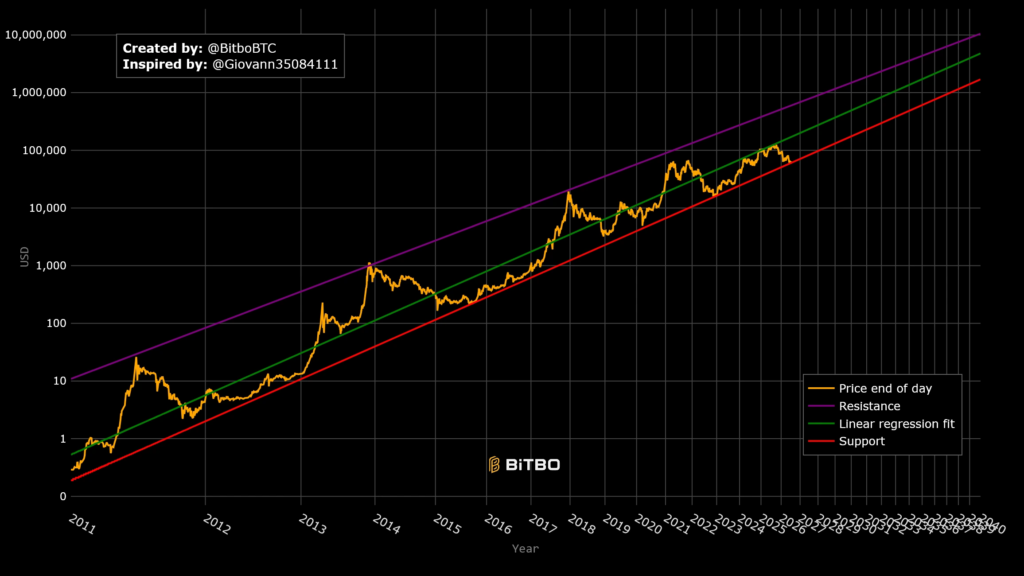
Right now, he acknowledges, sentiment is subdued. On the day of the interview, Bitcoin was trading around the $62,000 mark. The vibe, as he put it, was down. “We’re in the bear market now.” But for someone who has been shouting from the rooftops since 2018, a bear market is less a crisis than a familiar rhythm.
“If you look over the long run,” he says, “it’s going to grow massively.”