



TL;DR
- Circle secured regulatory approval in France under MiCA, enabling licensed crypto operations.
- The move allows USDC and EURC services to expand across the EU under a single framework.
- The development signals growing alignment between crypto firms and formal regulation in Europe.
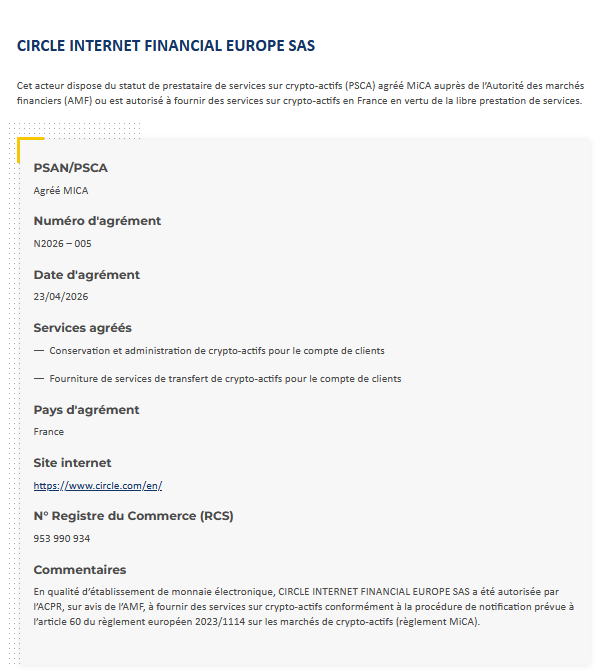
Circle has secured regulatory approval in France under the European Union’s Markets in Crypto-Assets (MiCA) framework, allowing the company to operate as a licensed crypto-asset service provider. The move enables it to offer regulated stablecoin services, including USDC and EURC, across the bloc.
The authorization was granted by France’s financial regulator, enabling Circle’s local entity to operate within one of the first fully active MiCA jurisdictions. The approval comes as the MiCA regulation in the EU begins to standardize crypto oversight across member states.
What the Approval Allows
The license enables Circle to provide a range of crypto-asset services. These include issuance, custody, and the transfer of digital assets. A central component of this approval is the ability to distribute and manage its stablecoins, USDC and the EURC stablecoin, under MiCA compliance standards.
This means Circle can now offer both stablecoins within a regulated environment across EU member states. The framework imposes requirements on transparency, reserves, and operational practices. These rules aim to reduce risk for users and institutions interacting with digital currencies.
By meeting these conditions, Circle positions its products as compliant alternatives in a market that is shifting toward stricter oversight. This move also supports USDC’s Europe expansion under a regulated framework.
>>> Read more: France Tightens AML Probes as EU Oversight Expands
Passporting Across the European Union
A key feature of MiCA is the ability for licensed firms to passport their services across all EU countries. Companies no longer need separate approvals in each jurisdiction. Instead, a single license can unlock access across the bloc.
With regulatory approval secured in France under MiCA, Circle can extend its services across the EU without additional national licenses. This effectively gives the company a single framework to operate cross-border.
France is emerging as a key hub for crypto regulation under MiCA, with regulators actively engaging global firms seeking early authorization.
Stablecoins Enter a Regulated Phase
The approval highlights the evolving role of stablecoins within regulated financial systems. USDC is pegged to the US dollar, while EURC is tied to the euro. Both are designed to maintain stable value and support digital transactions.
Under MiCA, stablecoin issuers must meet strict requirements related to reserve backing and disclosure. These rules are intended to address concerns around transparency and financial stability.
Circle’s ability to operate within this framework suggests that regulated stablecoins may play a growing role in payments, remittances, and financial infrastructure across Europe.
Strategic Positioning in a Changing Market
The timing of the approval is notable as firms race to secure licenses under the new EU regime. Early entrants may benefit from regulatory clarity. They may also gain an advantage as institutions and users look for compliant partners.
Circle’s approval in France under MiCA reflects a broader shift in the crypto industry toward regulated growth. Companies are increasingly aligning with formal frameworks to expand their reach and build credibility.
At the same time, competition is expected to intensify as more firms pursue similar approvals. The long-term impact will depend on adoption and whether regulated offerings can match the flexibility seen in less restrictive markets.
>>> Read more: Drift Hack Lawsuit Targets Circle Over USDC Transfers
What Comes Next
As MiCA implementation continues, more approvals are expected across the EU. This will shape a new regulatory landscape for digital assets. Circle’s entry into this framework marks an early step in that transition.
The coming months will likely show how effectively companies can scale under these rules. It will also indicate whether regulated stablecoins gain traction among businesses and consumers.