


TL;DR
- Several developments have reshaped the dormant Bitcoin wallet lawsuit since Noah Doe filed, including wallet activity, a court stay, and the appearance of an opposing claimant.
- The new developments both challenge and strengthen different parts of the plaintiff’s legal theory, making the case more complex.
- A July 14 hearing could provide the first indication of how the court views prolonged wallet inactivity under New York property law.
Since filing the complaint with the New York Supreme Court earlier this year, Noah Doe rested his lawsuit on a novel legal theory. The anonymous plaintiff asked the court to declare him the legal owner of 39,069 Bitcoin wallets that he claims were abandoned under state law.
According to widely reported estimates those wallets held roughly 3.7 million BTC, currently worth about $285 billion.
Two months later, several developments have reshaped the case. New questions arose in a dispute that was already testing the boundaries of digital property law.
Dormant Wallets Are Beginning to Move
The first major development since the lawsuit became public has been a series of Bitcoin movements involving wallet addresses included in, or associated with, the complaint.
Early reports highlighted individual Bitcoin wallets becoming active after roughly 15 years of inactivity. Attention later shifted to Wallet No. 137 in the plaintiff’s own list. After remaining dormant since late 2019, it moved 1,878.57 BTC. Additional movements followed throughout June.
Galaxy Research has since reported that 52 named wallets have moved a combined 34,335 BTC since the lawsuit was filed. More than 12,000 BTC transferred after wallet owners were formally notified through on-chain messages.
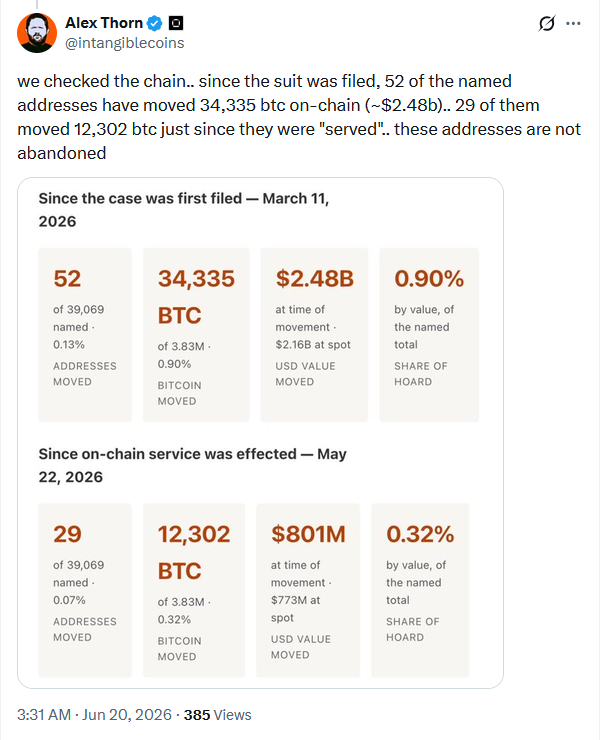
The activity complicates one of the lawsuit’s central arguments.
The complaint relies heavily on the idea that prolonged inactivity, through multiple Bitcoin market cycles, supports the conclusion that users abandoned the wallets. If someone holding the private keys can still access an allegedly abandoned wallet, inactivity alone becomes a less reliable indicator of abandonment.
At the same time, the plaintiff could point to the same developments as evidence that the notification process worked as intended. Owners who still controlled their wallets had an opportunity to identify themselves after receiving notice. Yet, thousands of other addresses remain inactive.
Whether that distinction ultimately carries legal weight is one of the questions the court may eventually have to answer.
The Court Pressed Pause
The court pause was separate from the wallet movements.
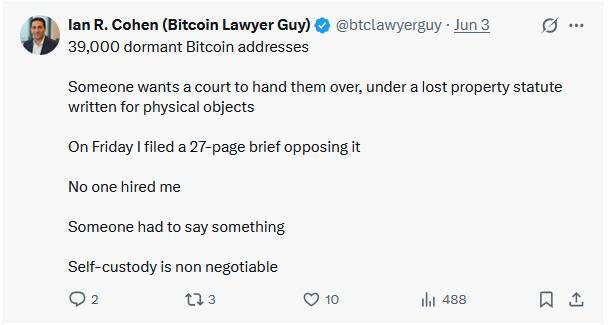
Attorney Ian R. Cohen moved on May 29 for permission to file an amicus curiae, or “friend of the court,” brief opposing the plaintiff’s request for declaratory relief. On June 5, Justice Kathy J. King stayed the proceedings and scheduled a July 14 hearing to consider the amicus motion.
The court has not expressed any view on the merits of the lawsuit. But the stay suggests the judge wants additional legal input before deciding how to proceed with a case that raises several novel questions about blockchain technology and traditional property law.
The hearing could provide the first indication of how the court intends to approach those issues.
The Lawsuit May No Longer Be One-Sided
One unusual aspect of the case was the absence of identifiable defendants.
The plaintiff listed the wallets John Does 1 through 39,069 because their owners were unknown. That raised the possibility that the court would be asked to evaluate the legal theory without anyone directly challenging it.
That may no longer be the case.
Reporting identifies a pseudonymous respondent, John Doe 33, as having filed a notice of appearance on June 30. If the court recognizes the appearance, the proceedings could become substantially more adversarial.
Instead of examining only the plaintiff’s interpretation of New York property law, the court may hear competing arguments over whether users ever abandoned the wallets and whether publicly visible blockchain addresses can legally equal found property.
The Theory Meets Resistance in Bitcoin Wallet Lawsuit
Three weeks ago, Noah Doe’s legal theory rested on a series of absences: no owners coming forward, no opposing legal analysis, and no named defendant contesting the claims.
Each of those absences has since been filled.
Wallets moving on-chain suggest that at least some owners still hold their private keys. Cohen’s proposed amicus brief supplies the adversarial legal analysis the case initially lacked. John Doe 33 supplies an actual respondent.
None of this resolves whether a cryptocurrency wallet can be treated as lost property under New York’s Article 7-B. But the plaintiff’s theory must now survive exactly the kind of scrutiny it spent its first month proceeding without.
That scrutiny will begin in earnest at the July 14 hearing. The proceeding is unlikely to resolve the case, but it could answer a narrower and more immediate question: whether Justice King treats prolonged wallet inactivity as meaningful evidence of abandonment, or whether she finds persuasive Cohen’s argument that dormancy proves little when users can simply hold private keys securely without ever using them.
How the court frames that threshold issue, inactivity as evidence or inactivity as legally insignificant, is likely to shape every filing that follows. It may also influence whether John Doe 33 is permitted to continue pseudonymously and whether additional wallet holders decide to come forward after seeing how the court responds.