


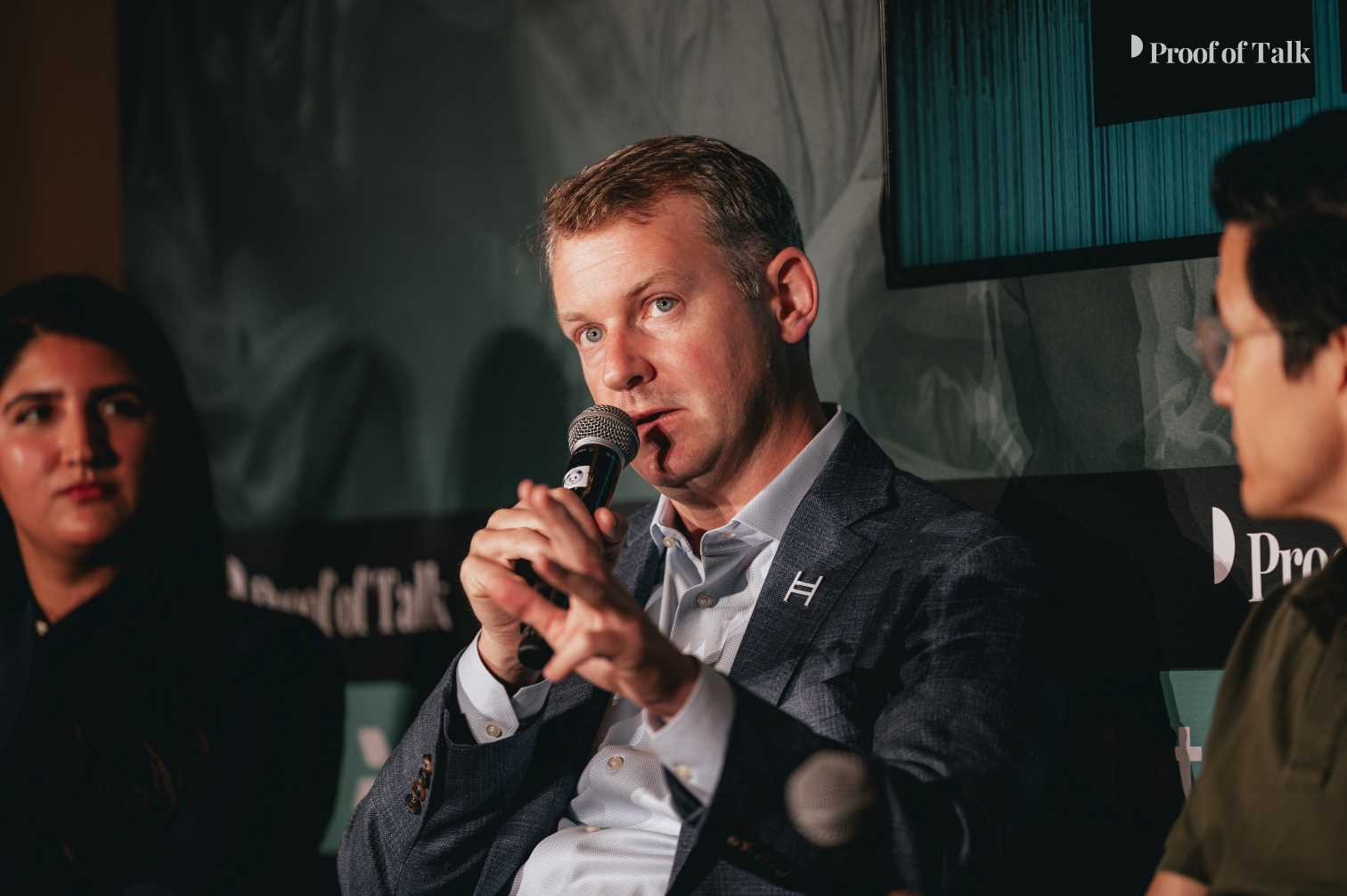
Gregg Bell has spent two decades at the intersection of traditional finance and digital markets. He thinks the migration from bank account to wallet has already begun — quietly, invisibly, and faster than anyone expected.
There is a migration underway in global finance that most people have not noticed. It is happening beneath the surface, inside the systems that banks, asset managers, and central banks use to move money between each other. By the time it reaches ordinary people, the infrastructure will already be in place. The transition will feel seamless. That, at least, is the plan.
Gregg Bell, Chief Investment Officer at Hashgraph, the enterprise software company that builds on top of Hedera’s network, has had a front-row seat to every stage of this shift. He has watched it from credit hedge funds, from Wall Street trading desks, from the earliest days of crypto lending, and from inside one of the world’s largest cryptocurrency exchanges during its most turbulent years. Now he is at Proof of Talk in Paris, a summit gathering the architects of the financial infrastructure most people will one day use without knowing it exists.
“The migration from a bank account or a securities account to a wallet,” he says, “is what we are living through in real life right now.”
The road and the vehicle
To understand what that means, it helps to understand what Hedera is, and what Hashgraph does. Hedera is a public network, similar in purpose to a blockchain but built on a different underlying technology called a hashgraph. It allows transactions to settle in seconds at a fraction of a cent. While most blockchains are governed by anonymous participants Hedera is overseen by a council of some of the world’s largest corporations; Google, IBM, FedEx, Deutsche Telekom, and McLaren among them. Each council member has an equal vote. Hashgraph is a separate but related company that builds enterprise software and deploys capital to accelerate adoption on top of that network. If Hedera is the road, Hashgraph builds the vehicles institutions use to drive on it. It also funds projects that put those vehicles into production.
Two decades at the border
Bell’s career did not follow a straight line to this point. He started at Silver Point Capital, a multi-billion dollar credit hedge fund, before moving to the Royal Bank of Scotland as a trader and investment banker in structured products. He then joined ArrowMark Partners, another multi-billion dollar hedge fund, where he focused on investment analysis and trading. From there, he co-founded A3 Financial Investments, building out its asset management business, and Salt Blockchain, where he served as both Chief Investment Officer and Chief Operating Officer. He helped pioneer the crypto-backed lending market at a time when the concept was genuinely novel. A stint leading growth at Binance during its most turbulent years followed. And now this.
The through-line, he says, has always been the same: finding where the inefficiencies are and building the infrastructure to remove them.
The foundations are being laid now
What is easy to miss from the outside is that this migration is not theoretical. It is not a roadmap or a whitepaper. It is happening in production, at some of the largest financial institutions in the world. It’s just not happening yet in a way that touches ordinary customers.
In the UK, Lloyds Banking Group and Aberdeen, one of the country’s largest asset managers, completed a trade last year that their compliance teams would have refused just two years earlier. Rather than selling investments and wiring cash to meet a routine margin requirement, the slow, expensive, traditional method, they transferred digital versions of fund units and government bonds directly, in near real-time, on Hedera. They moved collateral and settled the trade with neither side touching cash.
“The problem being solved was counterparty risk,” Bell explains. “In the past, and I’ve done this myself, back in my early investment banking days, in order to meet margin requirements, you often had to revert to cash. You’d sell out of a position, wire fiat from one bank to another. That’s a reduction in your return, and it’s a slow, cumbersome process. When you can transfer a tokenized security intraday, you’re maintaining assets in an investable, yield-bearing format while reducing counterparty risk. That’s a real value add.”
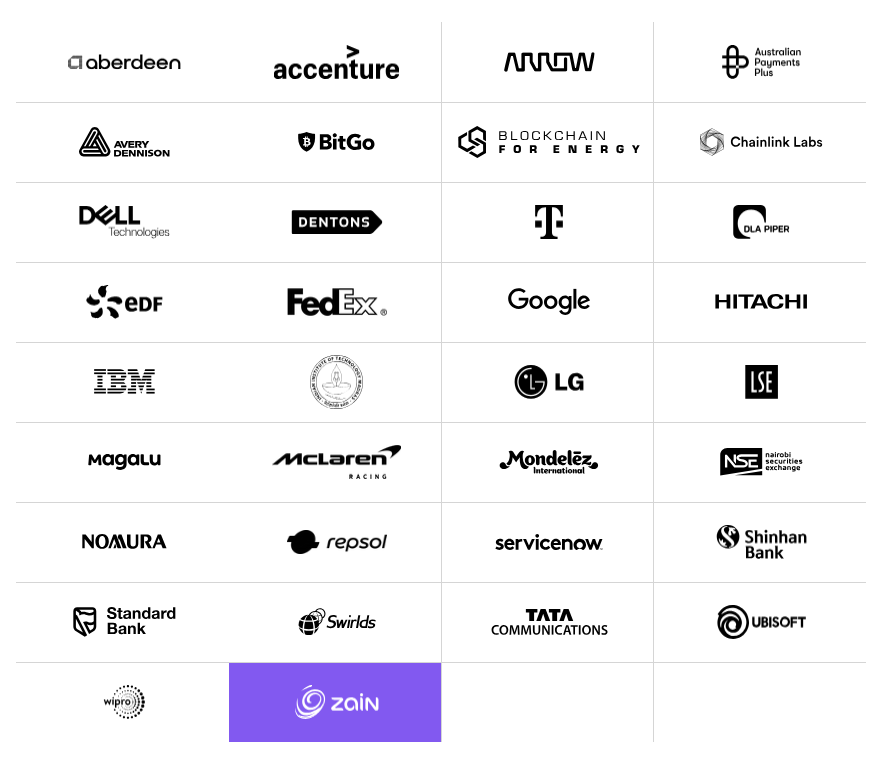
“Hedera is like the S&P 500. It provides a diversified exposure to Fortune 500 companies across a variety of industries — from tech giants like Google and IBM to investment banks like Nomura, asset managers like Aberdeen, corporates like FedEx, and entertainment firms like Ubisoft.” — Gregg Bell, CIO, Hashgraph
Down under, ahead of the curve
In Australia, the Reserve Bank used HashSphere, Hashgraph’s private, invitation-only version of the Hedera network, to mint a central bank digital currency made available exclusively to its member banks. Those banks created their own tokenized deposits, backed by that central bank currency and carrying the full faith and credit of the Australian government. The banks could then service their own clients with these instruments while the details of transactions remained private. The whole system remained connected to Hedera’s public network, allowing access to broader liquidity when needed. This was Project Acacia, which ran across 2025. Its use case: settling wholesale fixed income products using tokenized deposits. Quiet, technical, and almost entirely unreported outside specialist publications.
Neither of these is a retail story. The ordinary bank customer was nowhere near either transaction. But the point Bell makes, and it is worth sitting with, is that the infrastructure being built now is the same infrastructure that retail will eventually run on. The wholesale layer always comes first.
The plumbing nobody sees
Bell is direct about what needs to happen before trades like these become routine. The technology already exists, but it requires the alignment of cost structures, service providers, and regulatory understanding within each firm’s business logic. “Once that calculus is embedded,” he says, “then we’ll see more and more collateral mobility experiments and deployments.”
The friction is not resistance
Traditional finance does not resist technology. It has adopted technology consistently and aggressively wherever it demonstrably reduces cost and risk, from electronic trading to real-time payments to algorithmic risk management. What slows adoption of blockchain infrastructure is something different and more specific: the practical complexity of aligning every part of a large institution simultaneously.
“Adoption is not just a decision from a technology department or innovation department,” Bell says. “It’s a decision throughout a variety of different executive offices, whether that’s compliance, regulatory, the finance department. All of these concerns need to be addressed.”
That process has become significantly more informed, he says, as regulation has clarified — particularly in the United States, where legal ambiguity around holding digital assets on institutional balance sheets had artificially elevated the perceived risk of adoption. As that ambiguity has reduced, institutions have been able to move from pilot projects into production deployments.
There is, however, a different kind of friction that Bell is more candid about. It comes from within the industry itself. He uses the word “tribalism” carefully but deliberately.
“Despite the industry being called Web3, it is anything but a web. It is very siloed.” — Gregg Bell, CIO, Hashgraph
The blockchain world is fragmented. Dozens of networks, each with its own architecture, its own rules, its own community, and largely, its own walls. Assets held on one network cannot easily move to another. The workarounds that exist, known as bridges, have proven dangerously vulnerable. Such concentrated pools of assets sitting in third-party systems have been drained for billions of dollars in repeated exploits. “They are contrary to the decentralisation structure of the networks themselves,” Bell says.
Building the translator
Hashgraph’s proposed answer is called CLPR, pronounced Clipper, a cross-ledger protocol currently in development that takes a different architectural approach. Instead of pooling assets in a vulnerable intermediary, it aims to enable the consensus algorithms of two different blockchain networks to communicate directly with each other. No pool. No trusted third party.
“It’s as if you rolled back the clock to the early days of the internet,” Bell says. “If Yahoo could never speak to AOL, if your emails could only send to one network — it’s less beneficial to everyone.”
Bell is clear that CLPR is still in development, not yet live. And he is careful to frame it not as a prerequisite for the migration already underway, but as something that would meaningfully accelerate it. “Assets will move from one network to another in a safe and sound manner. And that is going to lead to adoption.” He frames it explicitly as a rising tide; infrastructure that benefits every network, not just Hedera. The tribalism problem he identifies is not one that any single network can solve by competing harder. It requires the kind of shared infrastructure that nobody owns.
The corporate payment comes first
The stablecoin conversation has matured considerably in the past two years. Regulators in the US, Europe, and Australia are now treating digital versions of currencies, stablecoins, as serious payments infrastructure and no longer as mere crypto trading instruments. Shinhan Bank in South Korea has run cross-border stablecoin pilots on Hedera. Bank consortiums in the Philippines have used the network for cross-border asset movement.
Bell is specific about where he sees the clearest near-term traction: bank-to-bank cross-border payments, where fees, costs, and friction are greatest, and corporate invoice settlement, where stablecoins offer a programmable, low-cost alternative to traditional wire transfers. “What’s very clear from the institutional adoption is that stablecoins are the means by which payments for goods and services will be facilitated on a corporate level,” he says. “That to me is quite exciting — because that’s paying invoices in stablecoins.”
But he flags a problem on the horizon that receives almost no attention in mainstream coverage. If every regional bank or national bank becomes an issuer of its own tokenized deposit, the result could be a fragmentation problem at the issuer level that mirrors the fragmentation problem at the network level. A corporate holding their local bank’s tokenized dollar may find it simply not accepted elsewhere. The acceptance problem would require the equivalent of a clearing house function the industry has not yet built.
“We’re going to move from funding crypto exchanges to actually paying for goods and services with stablecoins,” he says. “But in order to do that, those assets need to be interchangeable.” The migration’s next chapter, in other words, depends on solving a problem that predates blockchain. Competing financial institutions must agree on common standards.
What the destination looks like
Proof of Talk, as an event, is a room full of people who think about this constantly. The institutions, the networks, the protocols, the compliance frameworks. Bell is asked to step back from all of it and describe what success actually looks like; not in technical terms, but in human ones.
“It’s getting in the car — or McLaren, in Hedera’s case — and driving from A to B very fast, and you’re not thinking about how, but you’re thinking about the destination and that it works.” — Gregg Bell, CIO, Hashgraph
Hedera under the hood. Invisible. Functioning. That is his definition of success.
The wallet replacing the bank account will not feel like a revolution when it happens. It will feel like the ATM replacing the bank teller, or online banking replacing the branch visit. A gradual shift in where and how people interact with their money. It will not be driven by consumer demand for new technology. The infrastructure improvements will simply make the new way easier, cheaper, and more reliable than the old one.
For those who simply want to keep using cash? “They will continue to use it, and that’s quite all right,” Bell says. “Sometimes handing someone a dollar bill might be the right tool. It’s very difficult to do across an international border that’s a different time zone away.”
The migration does not require everyone to come along at once. It just requires that when they are ready, or when the system around them has quietly shifted, the infrastructure is already there.